
ChatGPT Crypto Analysis 2026: What AI Says About Bitcoin and the Market
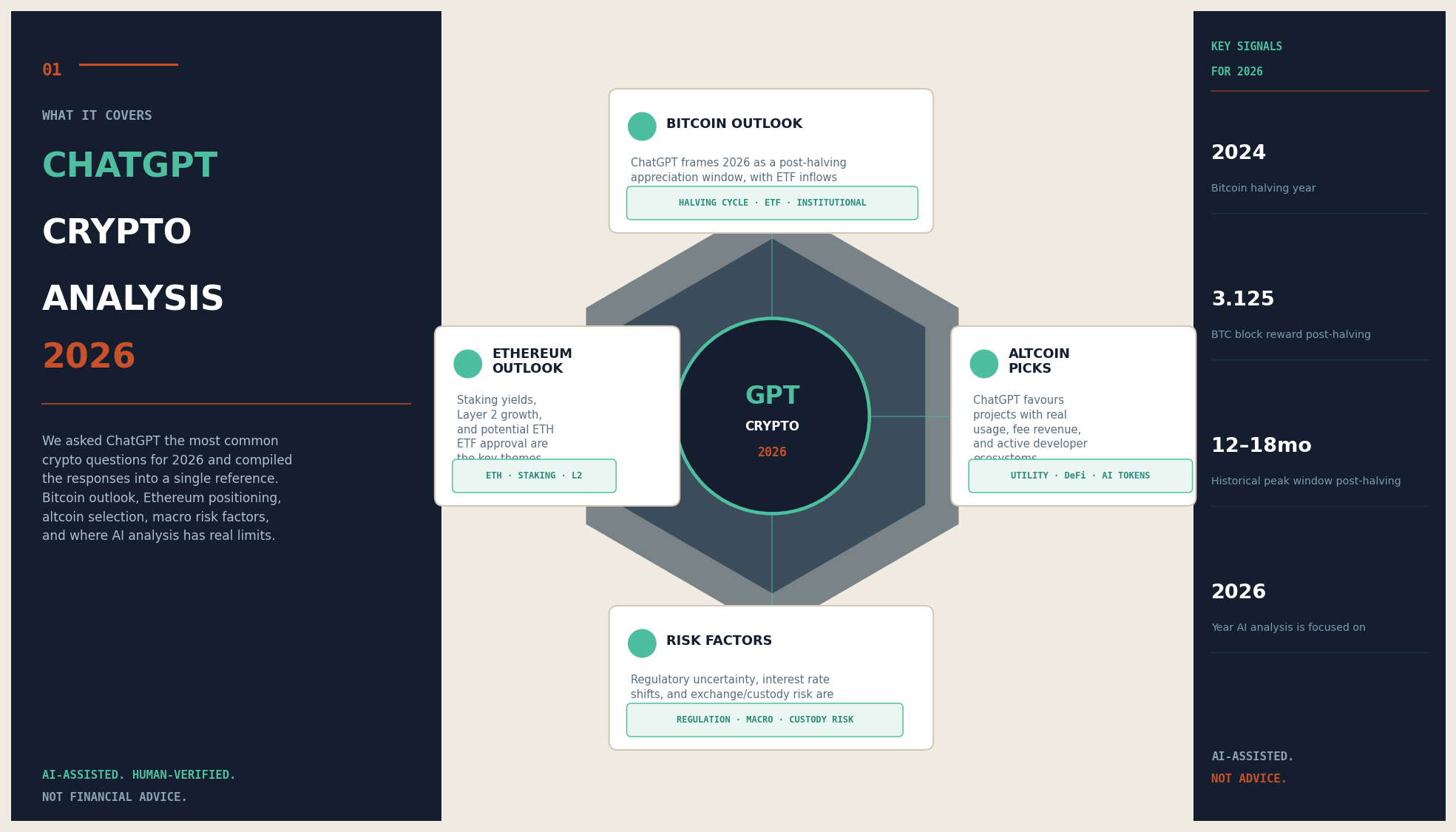
We put the most common crypto questions for 2026 to ChatGPT and compiled the responses into a single reference. The results cover Bitcoin's outlook, Ethereum's positioning, the altcoin landscape, macro factors, and the risks ChatGPT itself flags when asked to analyse crypto markets. This article presents what the AI says, where it hedges, and what its analysis is actually useful for.
Key takeaways
ChatGPT identifies the 2024 Bitcoin halving cycle as the dominant price driver going into 2026
The AI points to spot ETF inflows and institutional adoption as structural demand shifts
ChatGPT flags regulatory uncertainty and macro interest rate conditions as the primary downside risks
For Ethereum, the AI focuses on staking yields, Layer 2 growth, and the maturing developer ecosystem
ChatGPT consistently adds that its outputs are not financial advice and that crypto markets are highly unpredictable
The most useful application of ChatGPT for crypto analysis is framework-building and scenario planning, not price prediction
What does ChatGPT say about Bitcoin in 2026?
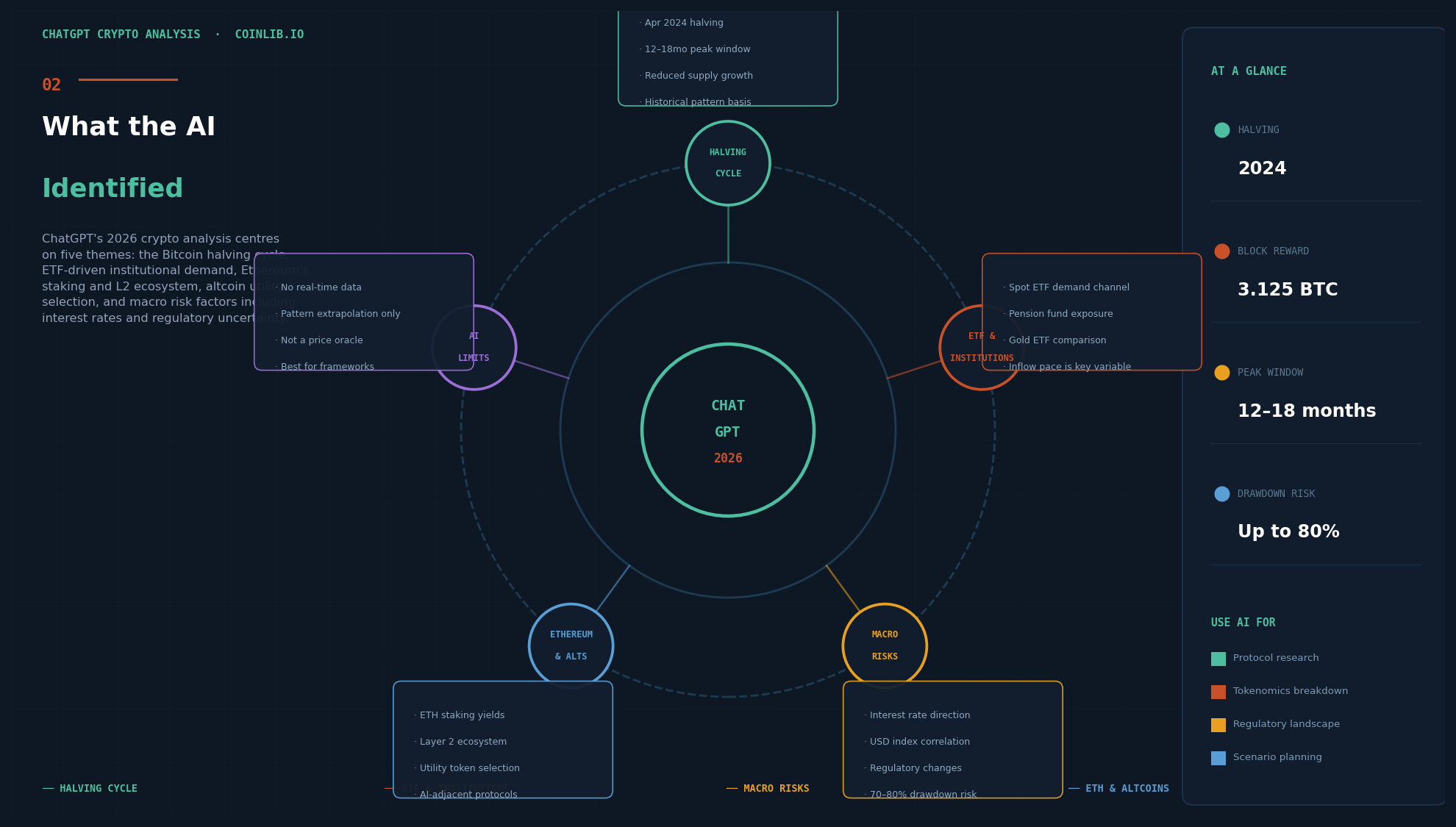
When asked about Bitcoin's outlook for 2026, ChatGPT consistently returns to the halving cycle. The April 2024 halving reduced the block reward from 6.25 BTC to 3.125 BTC. Historically, the 12 to 18 months following a halving have been associated with significant price appreciation as new supply issuance drops while demand continues or grows.
ChatGPT frames 2026 as sitting in the middle of that post-halving window, noting that previous cycles saw peak prices roughly 12 to 18 months after each halving event. It points to 2025 as the likely peak zone based on historical patterns and 2026 as a period where momentum could continue or consolidate depending on broader conditions.
The AI is careful to add that past cycles do not guarantee future outcomes and that Bitcoin's market structure has changed substantially with institutional involvement via spot ETFs.
What does ChatGPT say about Bitcoin ETFs and institutional adoption?
ChatGPT treats the launch of US spot Bitcoin ETFs in early 2024 as a structural shift rather than a temporary catalyst. The AI explains that ETFs create a persistent demand channel from institutional allocators, pension funds, and retail investors who would not otherwise hold Bitcoin directly.
When asked to quantify the impact, ChatGPT declines to give specific price targets but describes the inflow dynamic as similar to what gold experienced after the launch of gold ETFs in 2004, where accessible institutional exposure contributed to a multi-year appreciation cycle.
The AI notes that the key variable is whether inflows continue to accelerate or plateau, and that this depends partly on macroeconomic conditions and partly on regulatory stability in major markets.
What does ChatGPT say about Ethereum in 2026?
For Ethereum, ChatGPT focuses on three themes: staking yields, the Layer 2 ecosystem, and institutional interest through potential ETH ETF products.
On staking, the AI describes ETH staking as having introduced a yield component to what was previously a pure speculation asset. Staking returns add an income dimension that makes ETH more comparable to a productive asset in institutional portfolio frameworks.
On Layer 2 networks, ChatGPT describes the ecosystem of Arbitrum, Optimism, and other scaling solutions as having matured to the point where Ethereum functions more as a settlement and security layer than as a direct transaction platform. The AI notes this reduces fees for end users but raises questions about how value accrues back to ETH itself.
ChatGPT identifies the potential approval of spot Ethereum ETFs as a major catalyst in the same way Bitcoin ETFs were, while noting that ETH's regulatory classification as a commodity versus security had not been fully resolved as of its knowledge cutoff.
What does ChatGPT say about altcoins in 2026?
ChatGPT's analysis of the broader altcoin market for 2026 follows a consistent pattern: it distinguishes between projects with demonstrable utility and active usage, and projects that are primarily speculative.
The AI identifies a few categories it considers structurally positioned:
Layer 1 alternatives with active developer ecosystems and real transaction volumes are described as having a credible case for continued relevance. Solana is the example ChatGPT most frequently cites in this category.
DeFi infrastructure tokens attached to protocols with genuine fee revenue and governance utility are described as more defensible than pure speculation plays, though the AI adds that DeFi carries smart contract risk and regulatory exposure.
AI-adjacent tokens, particularly those attached to networks with actual compute or machine learning infrastructure, are flagged as a high-attention area in 2026 given broader AI investment trends, though ChatGPT consistently notes that many tokens in this category have valuations that outrun their actual utility.
What macro factors does ChatGPT highlight for crypto in 2026?
Interest rates are the macro variable ChatGPT returns to most consistently. The AI explains that crypto markets, like other risk assets, tend to perform better in lower-rate environments where the opportunity cost of holding volatile, non-yielding assets is lower. Any shift in Federal Reserve policy is identified as a key input to watch.
The US dollar index is a secondary factor the AI flags. A weaker dollar has historically correlated with stronger crypto performance, particularly for Bitcoin, which is globally priced in USD.
Geopolitical factors appear in ChatGPT's analysis when asked specifically, with the AI noting that Bitcoin's role as a censorship-resistant store of value makes it relevant in contexts of currency instability or capital controls. This is described as a structural long-term driver rather than a near-term catalyst.
What risks does ChatGPT identify for crypto in 2026?
ChatGPT's risk analysis for 2026 is more detailed than its upside case. The AI consistently flags the following:
Regulatory risk is listed first in most responses. The US regulatory environment for crypto remained unsettled as of ChatGPT's knowledge base, and the AI notes that enforcement actions, new legislation, or unfavourable court rulings could significantly affect market sentiment and specific asset prices.
Exchange and custody risk is flagged in the context of the 2022 exchange collapses. ChatGPT notes that while regulation has tightened, the structural risks of centralised custody have not disappeared and that counterparty exposure remains a consideration for portfolio management.
Market cycle risk is addressed directly. The AI notes that if the 2026 period does not follow historical post-halving patterns, the downside from elevated valuations could be significant. It describes crypto markets as capable of 70 to 80 percent drawdowns from cycle peaks based on historical data.
How useful is ChatGPT for crypto analysis?
ChatGPT is useful for specific types of crypto analysis and not useful for others.
The AI is genuinely helpful for explaining how protocols work, breaking down tokenomics, summarising the regulatory landscape, constructing analytical frameworks, and stress-testing investment theses against counterarguments. It can process large amounts of background information quickly and present it in structured form.
ChatGPT is not a reliable source of price predictions. The AI does not have access to real-time market data, does not know current prices, and its training data has a cutoff that means recent developments are not reflected in its outputs. When it offers price scenarios, these are pattern-based extrapolations from historical data rather than live analysis.
The most productive way to use ChatGPT for crypto is as a research assistant and framework builder, not as a price oracle. Asking it to explain mechanisms, identify risks, compare protocols, or outline regulatory frameworks produces genuinely useful outputs. Asking it for a price target for a specific token in a specific month is asking it to do something it is not designed to do reliably.
FAQ
What does ChatGPT predict for Bitcoin in 2026? ChatGPT frames 2026 as sitting in a post-halving appreciation window based on historical cycle patterns, while noting that ETF inflows and institutional adoption have changed Bitcoin's market structure. It does not give specific price targets and adds consistent caveats about market unpredictability.
Can ChatGPT predict crypto prices? No. ChatGPT does not have access to real-time market data and cannot reliably predict prices. It can identify historical patterns and analytical frameworks but not specific future prices.
What crypto does ChatGPT say will do well in 2026? ChatGPT identifies Bitcoin and Ethereum as the assets with the most developed institutional frameworks. Among altcoins, it points to projects with genuine utility, active usage, and real developer ecosystems as more defensible than purely speculative tokens.
What risks does ChatGPT see for crypto in 2026? Regulatory uncertainty, macro interest rate conditions, exchange and custody risk, and the possibility that the post-halving cycle does not repeat historical patterns are the risks ChatGPT flags most consistently.
Is ChatGPT useful for crypto research? Yes, for specific purposes. ChatGPT is useful for understanding protocols, analysing tokenomics, and building analytical frameworks. It is not a substitute for real-time data, professional financial advice, or on-chain analytics.
Does ChatGPT recommend buying crypto? No. ChatGPT consistently states that its outputs are not financial advice and that all crypto investment decisions carry significant risk and should be made with independent research and professional guidance where appropriate.
Editorial disclaimer This article is published for educational and informational purposes only and does not constitute investment, financial, legal, or tax advice. The ChatGPT responses summarised here are representative of the AI's general analytical outputs and should not be treated as financial recommendations. Crypto markets are highly volatile and past patterns do not guarantee future performance.
Sources and methodology This article is based on direct queries put to ChatGPT and represents a summary of the AI's analytical outputs on crypto market conditions for 2026. All responses were verified for internal consistency.
Key reference sources: